Why was summer 2026 the season of data centers?
How opposing data centers went from fringe to default in a single summer, and what that says about AI in culture

A year ago, almost nobody could have told you what a hyperscale data center was. Data centers have been around for decades. They’re the kind of infrastructure that hums along in the background of a life. Now, people are flocking to oppose them.
Last month Data Center Opposition Report recorded more than 800 opposition groups across 49 states, with over 525,000 members and memberships up nearly sevenfold since December 2025. These opposition groups are having a real effect: they blocked or delayed over $150 billion in projects last year, and another $130 billion in the first three months of this year. New York paused every new large data center in the state. And, on a single day in July, people turned out to protest in 142 cities across the country.
Data center opposition has vividly penetrated popular culture. Most people would rather live near a coal plant than a data center, even though coal plants measurably raise the death rate of everyone living beside them. A recent ad for Liquid Death featuring Jason Kelce, a former NFL player, urged people to send their urine to cool down data centers instead of using water. From a specialist topic discussed only by experts and tech people, the discussion has exploded into every household in the United States.
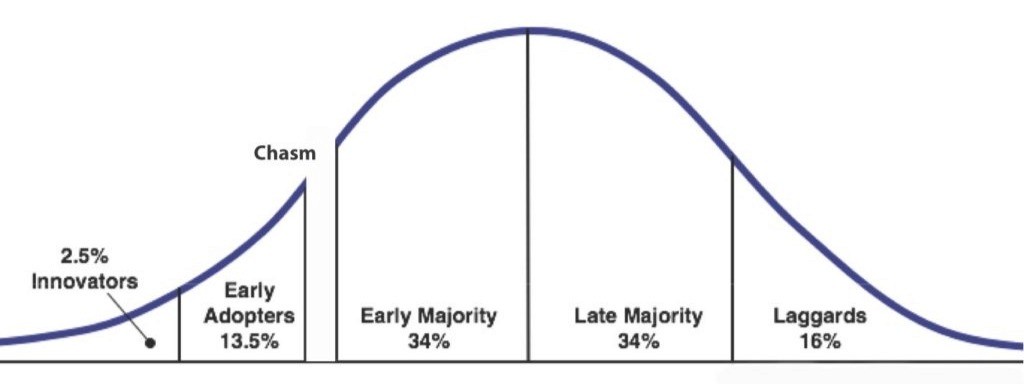
The innovation diffusion model describes how new ideas move through a population. First a small group adopts the idea first, on conviction, when there is nothing social to gain from it, such as the Wisconsin town where a retired developer scared Microsoft off. Then comes the hard part, the gap Geoffrey Moore called the “chasm,” between those committed few and the cautious majority who make up most of any population. The majority does not cross for a better argument, but on social proof, once enough people like them are already visibly “in”.
Being against a data center has plainly made that crossing, and fast.
Why now? Why are the loudest opponents so often people who have never lived near one? And what does it mean that a technology's most visible symbol became something the public agreed to hate before it agreed on why?
Fertile ground: the distrust was already there
In early August, Jasmine Sun reported that residents who lived near data centers rarely raised job loss or deepfakes when talking about AI. Instead, the issue that felt most urgent to them was how their local councils could sign an NDA and sell out their small towns to a giant corporation without public input. In cases like these, AI populism feels more about populism than about AI.
In other words, the anger didn’t start with data centers. It was already there, waiting for something concrete to attach to. This story repeats across the USA. Research has found that in communities everywhere, grievance has developed into insularity, and economic anxiety is at an all-time high: 54% of low-income and 44% of middle-income respondents believe they will be left behind rather than benefit from generative AI. In fact, AI is becoming a focal point for general distrust of institutions and corporations, as many people feel the system is stacked against them; people expect AI, in particular, to be something done to them, not for them.
The benefits a data center promises are exactly the kind that people have stopped trusting in the last few years. Anis Heydari, a Knight-Bagehot Fellow in Economics and Business Journalism at Columbia University, points out that everything a data center promises is intangible: tax revenue, sovereign AI, control over your data, a faster phone. None of it is something that you can see or feel. “So when a politician or a corporate director is sitting in front of you saying, ‘We need to do this thing that will have a cost to you, whether is a financial, visible, or resource cost, and trust us, you're going to get something good out of this,’ it seems like many people are unwilling to trust that right now,” he argues.
Distrust like this runs deep and predates AI. Gallup has confidence in US institutions at a record low, with Americans across parties feeling as if the economy is “rigged” against them. And, as Paul Krugman points out, tech companies had lost the public's trust before AI became a topic we discussed at the dinner table. AI simply gave that distrust a new and vivid target: the technology now polls worse than ICE. And for the people who actually live beside a data center, the grievances are concrete: lost farmland, noise, traffic, and a process they had absolutely no say in.
Concrete harms: the data center is the thing you can actually see
AI is abstract. For the most part, you cannot see it, hear it, or touch it. The things people fear about AI are hard to express clearly and harder to act on. A data center is one of the few parts of the whole build that is physical, local, and decided at a local council meeting you can actually walk into. So it becomes the one place a diffuse fear can finally find focus in action.
Heydari puts the visibility at the heart of it: “When you go and fill your car up with gasoline, the most you see is the gas station. It's small. It's unobtrusive. You don't emotionally connect in your head that gas station needs hundreds of square kilometers of refineries and thousands of square kilometers if you add in the drilling sites and the pipeline transportation.” A data center gives you no such distance. “With data centers, you're seeing [...] giant buildings that don't have humans going in and out of them, and they make noise, and you think, what is this?” That, he argues, is how people weigh almost anything: “Humans tend to understand the consequences that they can see, or that they have a frame of reference that matches something they've experienced in their life.”
So against a backdrop of AI unease, the data center becomes the stand-in. AI itself gives you nothing physical to push against, but the building down the road has a permit, and a date, and that is where the fear can finally be expressed in action.
The safe-across-tribes signal
Part of the reason why the data centers discussion blew up this summer is that you can arrive at the objection from almost anywhere. The resistance passes through filters of several opposing ideologies at once.
On the right, key voices like Steve Bannon and Marjorie Taylor Greene are signing on. Bannon, Trump's former chief strategist, aired a segment last year describing data centers as “weapons labs” that are “being turned onto the population.” Marjorie Taylor Greene, former United States representative, has voiced strong opposition to rapid artificial intelligence expansion and federal data center policies. HumansFirst, a Republican-aligned AI advocacy group, expressed this legitimacy with their Day of Action.
But this is not a partisan movement. On the left, Bernie Sanders and Alexandra Ocasio-Cortez are championing data center resistance. Sanders, a Senator from Vermont, and Ocasio-Cortez, a U.S. representative from New York's 14th congressional district, introduced the Artificial Intelligence (AI) Data Center Moratorium Act in March 2026 to halt the construction of new large-scale AI data centers. Most recently, Abdul El-Sayed, Michigan's Democratic Senate nominee, has said there is no place where data centers and AI do not show up.
Agreement across this divide is rare, and this is exactly what makes the position so easy to hold. When your own side and the opposition have already landed in the same place, being against a data center costs you nothing socially. That is what lets the cautious majority pick it up.
Coolness over factualness
Every single industry on earth demands enormous resources to build. Golf courses, for example, use colossal amounts of water per day. They are often local environmental disasters, disrupting habitats and impacting surrounding land with chemical runoff from heavy use of fertilizers and pesticides. Plans to build a new one might spark local opposition. But they don’t affect national culture the same way. A golf course does not cause people who live nowhere near it to join a Facebook group to protest as a data center does.
That distant, voluntary joining signals a socially rewarded cause. This suggests that data center opposition is about what a data center stands for, and not just the water depletion they are alleged to cause. Water usage claims are often misinterpreted. But they persist in culture, even though data centers use far less water than is popularly claimed. It isn’t about the facts. As Heydari points out, little independent, confirmed research exists on what these projects can and will do to neighboring communities, and that vacuum fills with the worst assumptions rather than the best evidence.
Rising energy bills are the single most-cited reason for opposition (67%, Milltown Partners, May 2026), yet it is water, not bills, that travels. Water is something you can picture, and a tap running brown in a video is something you can feel in your mouth, and you don't need it explained. A fight over regional grid pricing and capacity auctions is real, better evidenced, and probably does more damage to the average household. Still, nobody is putting that on a protest sign. It doesn’t work as well emotionally or socially - and that is what proves the point. That is the whole mechanism in miniature, and it is a fact about communication, not about hydrology.
The local grievances are real and earned, from the broken promises to the NDAs to specific frustrations with local government officials. But the national furore is based on emotion, on giving a focal point to unease with a potentially destabilizing technology and a sense that the deck is stacked.
Opposing is the default now
Once a position has crossed into the majority on social grounds like these, correcting any single fact behind it does not pull people back, because the fact was never what was holding it there in the first place. The per-query water number is the clearest proof: it was wrong, it was corrected, and the belief continued to hold in popular culture as if nothing had happened.
When the evidence changes and the belief does not, you are past the point where evidence is steering anything. Once the opposition shifts from what a data center does to who is building it and whether they can be believed, no disclosure closes the gap.
Now that the distrust is socially justified, the early majority felt safe crossing the chasm. Being against data centers is now socially beneficial.
What’s next for the data center opposition movement?
So, will the anti-data-center position last?
When you ask why all of this happened in 2026, and not before, the simplest answer is that many projects were proposed at once, so a whole set of small, local stories suddenly connected into one national one. The hyperscalers all decided to scale at the same time, and the backlash simply tracked them, town by town, until from a distance many local opposition fights looked like a single movement.
It is tempting to think the fight might fade once the concrete is poured. But the evidence shows this is unlikely. Elon Musk's Colossus is already running outside Memphis, and opposition to it has only hardened since it went live with lawsuits over unpermitted gas turbines, noise complaints from people who live within a mile of it, and civil-rights action over the pollution it pumps into a largely Black neighborhood. A finished data center does not remove the target – it gives opponents something even more concrete to point at. So this movement might not cool down when the buildings go up; it actually might harden into place beside them.
The more important question might not be whether the data center fight survives but what it leaves behind. Support for AI regulation is already high, and what it has lacked is salience, the feel that something is urgent, close, and actionable. Data center opposition created exactly that: a way for a diffuse worry about AI to become a thing you could drive to on a Tuesday night and vote against. Will “I don't want this data center” ever become “I want this technology governed,” or do the two stay separate feelings that never quite meet?
And that is the real story of the summer. Not that a technology got a bad reputation, but that the public reached a verdict before the industry noticed a trial was underway. AI is no longer a debate to be won; many people have already decided to distrust it, and they decided it together, because it finally felt safe to say so out loud.