The Public Isn't Buying What the AI Industry Is Selling
It's time for a Different Kind of Ad
By Casey Shea, CHT, & Alice Anselmi, Seismic Foundation
Originally published in The Fault Line
In 1998, along highways crisscrossing the biggest cities in California, commuters were treated to one of the cleverest anti-tobacco ad campaigns ever. The ads, employing a tactic we know today as “subvertising”, so closely satirized the tobacco products they were lampooning that a quick glance at the image of two cowboys riding their horses at sunset could cause them to be mistaken for just another Marlboro billboard with their classic iconography, so ubiquitous they were at the time.
But this one had the brand nowhere in sight. Instead, the cowboys were in their post-smoking era. “Bob, I’ve got emphysema,” the billboard said.
The billboards are famous today, not just for their sardonically humorous takedown of one of the biggest cigarette brands in the world at the time, but because of who was paying for the ads: the tobacco industry.
The ads were commissioned by the California Department of Health Services with money paid out by the Tobacco Master Settlement Agreement, which allocated billions of dollars to individual states for local public health programs and anti-smoking campaigns.
It’s hard to remember today that there was a time when smoking was such a ritual of daily public life that its health effects weren’t just under-researched, they felt sort of irrelevant. It was only after many decades, and generations of addiction, that the findings became unequivocal enough to prompt the states to sue Big Tobacco.
Today, we are living inside what can sometimes feel like peak AI. A big part of the $1 trillion-plus investment in AI has been fed into slick and ubiquitous ad campaigns for products and companies that promise to optimize nearly every aspect of our lives. They’re on highway billboards, bus shelters, subway walls, and inside our laptops and social media feeds.
It’s no coincidence that the rush for ad spend comes at a time when we, the public, are already in a state of unease over AI. Our increasing dependency on – and addiction to – some of these products and platforms has become disconcerting. We sense it eroding the things that matter to us — from our relationships, to our cognitive skills, to our opportunities to contribute to the world. And that’s not to mention the potential catastrophic impacts of AI, which have recently broken through in mainstream discourse. To use the tobacco analogy, AI is in its “emerging health effects” phase – and it’s not looking good.
But so far, only a small handful of state legislatures have decided to act. So in the meantime, we thought to take it upon ourselves.
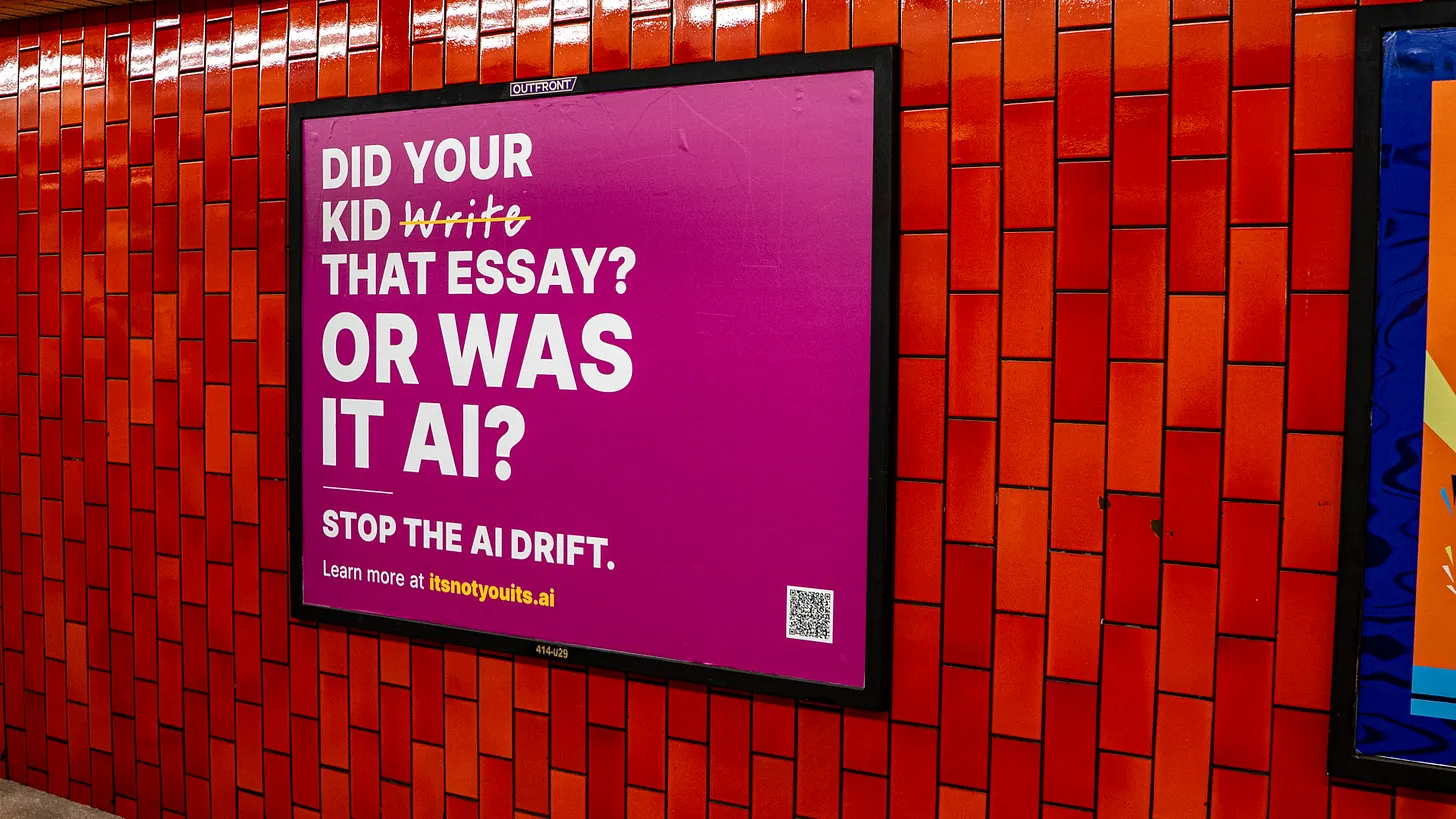
We at Center for Humane Technology and Seismic Foundation have partnered to roll out ads in the New York City subway system for a new campaign — one that explores how AI is eroding important parts of human life, and what we can do as individuals and a collective to stop it. The campaign, titled Stop the AI Drift, features short, snappy insights that drive not just clarity around common experiences with AI, but also conversation — with a fellow commuter, with a friend in text messages, or with followers online. These ads will raise awareness around a new phenomenon known as “AI drift,” or the gradual erosion of human abilities as we hand over more of our lives to AI.
Today, our media environment is more fractured than ever. People are getting information about AI from dozens of different places, often in small, incomplete pieces. It’s incredibly difficult for any one message to break through, and it’s even more difficult to compete with a multi-trillion-dollar industry determined to push its messaging about AI technology through. In order to really connect with the public, you need more than deep pockets and a big media buy. You need a strong, strategic idea. You need creative that people actually want to pay attention to. And you need a willingness to show up somewhere — and say something — in a way that people aren’t expecting. When it works, that breakthrough moment can be incredibly powerful, and change how people think about an issue.
That’s why we’ve built this campaign around AI Drift. People are uneasy about AI for a number of reasons, and one of the most salient is its effect on creative thinking. People can see that interacting frequently with AI is eroding their ability to work creatively, to empathize with those close to us, to look at problems and come up with solutions. In short, it’s eroding some of the things we value most about being human. This is something that we all need to look at carefully.
Not only was the “anti-Marlboro man” part of a successful campaign that continues to this day, but it succeeded in a very particular way; by getting people to think twice about their own personal relationship with a product that was once ubiquitous. This is a form of ‘culture jamming’ that we’re tapping into: we’re subverting the endless AI ads in the New York subway network today and exposing the underlying social costs. We ought to get to choose where AI belongs in our lives instead of drifting along on our current trajectory.
You’ll be able to see Stop the AI Drift ads in the New York City subway system now through late October. We hope you’ll snap a photo, strike up a conversation, and talk about where you’re seeing AI drift in your own life. Don’t forget to tag your pictures online with #AIDrift. And to learn more, visit itsnotyouits.ai.