AI is in the Public Eye
How a changing public consciousness will affect the way we discuss AI
Originally published in The Fault Line
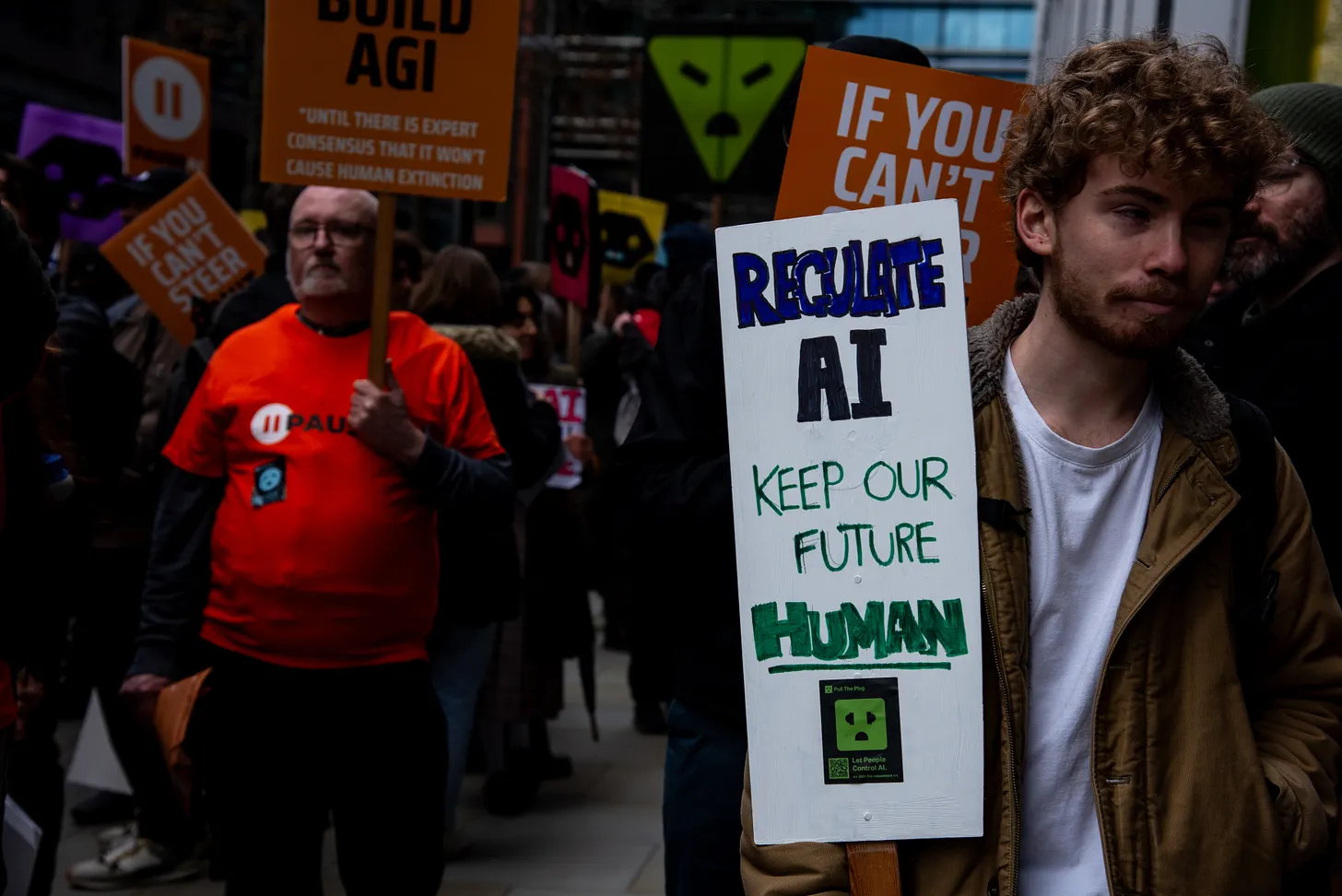
London, England, UK - February 28, 2026: A protester holds a placard during the ‘March Against The Machines’ Protest.
Something significant is changing in the way AI appears in popular culture and the media. Why did this happen, and why now?
When Jacob Coxon resigned from Anthropic on September 8th, he was the latest in a long line of safety-conscious AI experts to do so. What was remarkable was less his resignation than the reaction to it. After all, Coxon had many predecessors. All the way back in 2023, none other than Geoffrey Hinton resigned from Google so he could speak freely about the risks he saw coming. Many followed: William Saunders, Miles Brundage, Daniel Kokotajlo, Jan Leike, Ilya Sutskever, Rosie Campbell, Gretchen Krueger, Steven Adler, Mrinank Sharma, and many more. Sharma resigned just half a year ago (with poetry) and, though his departure was noted by the AI risk crowd, Washington and the mainstream media barely blinked.
Not so with Jacob Coxon. His resignation kicked off a flurry of engagement from policymakers in Washington, and an explosion of mainstream news coverage.
Suddenly it seems like everyone is talking about AI risk. And not just the fact of the risk - the type of risk, too. Never before has so much attention and earnest consideration been given to AI’s potential catastrophic risks.
If the same stimulus, when repeated, provokes a different response, the difference must be in the system being stimulated. And so it is today.
What changed?
This brings us to the critical question: why did policymakers and the media react so strongly to Coxon’s resignation specifically?
Part of the reason is that concerted action over time is effective. Research by the PR firm Edelman has found that most people need to encounter a novel message about 5 times before they accept it. Dedicated AI safety activists have been trying to raise the profile of AI risk with policymakers for years. This concerted attention has created a precedent.
The other part is that AI is rising rapidly in salience among important issues. We can see this in the polling data.
A year ago, we did a comprehensive study of attitudes towards AI in 5 countries, including the U.S. We found that people did worry about AI, but also ranked it very low in their list of important problems. In our poll, AI showed up as the 24th out of 25 problems next to last place. This January, polling firm Blue Rose ranked AI 29th of 39 issues: still in the bottom third, but rising fast. Their latest study, fielded in September, found a significant jump. Since January, AI has risen to 22nd place, sitting below civil liberties and privacy and just above freedom of speech. AI is no longer a fringe issue.
They also detected a significant and recent leap in Americans choosing AI when it was a binary comparison with a second issue:
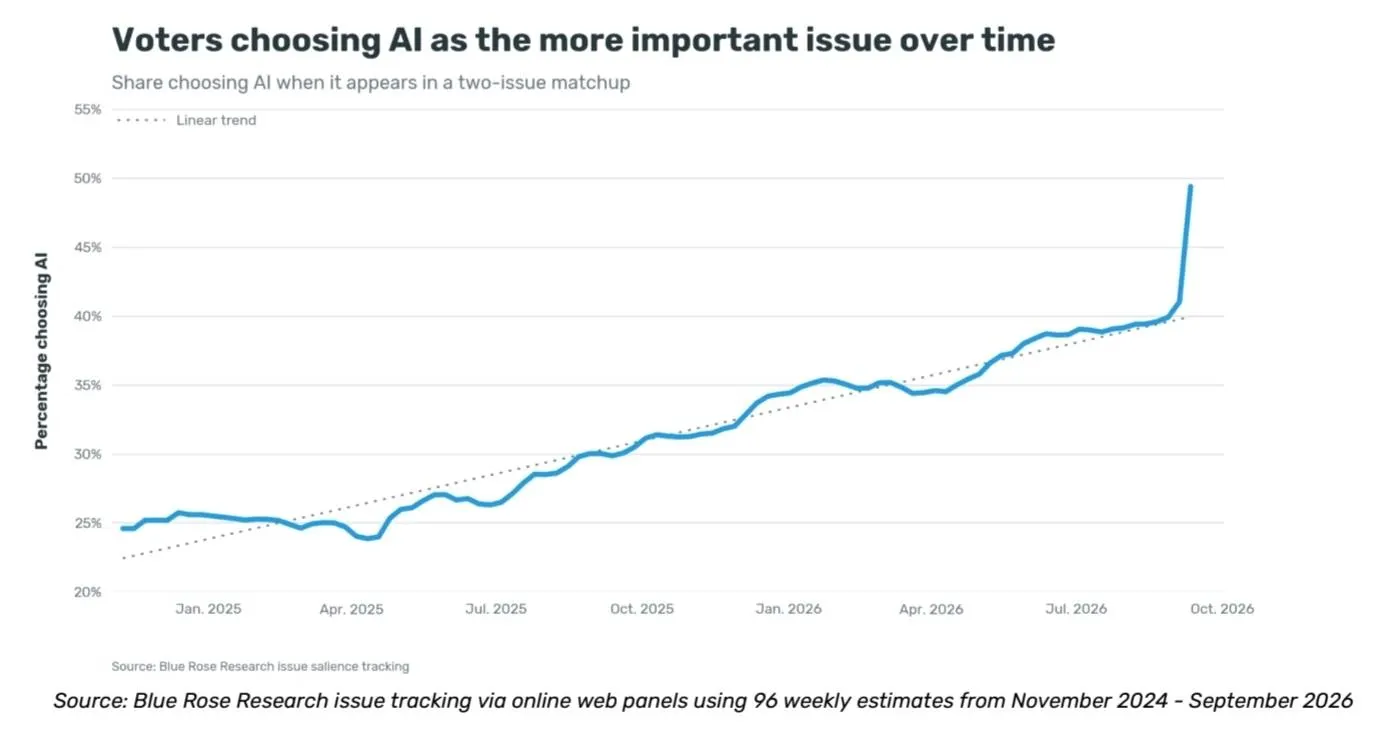
It seems that the perception of AI is reaching a turning point. This has shown up in action: The Data Center Opposition Report recorded more than 800 opposition groups across 49 states, with over 525,000 members and memberships up nearly sevenfold since December 2025. Over 700,000 people pledged to cancel ChatGPT in February, and this summer there were 142 protests against data centers in a single day.
The net effect of this, as we wrote in our analysis of the public furor over data centers, is that being an AI skeptic has gone from being a social liability to a social asset. Until this summer, saying out loud that you worried about AI marked you out: you were dismissible as a doomer who had spent too long on dark corners of the Internet, maybe, or a luddite, or someone who took science fiction a little too seriously.
That has quietly stopped being true.
This summer, voicing AI skepticism became emotional. It became socially acceptable. It even became cool. It also became politically acceptable. When both Bernie Sanders and Steve Bannon are on the same side of the issue, people know they can feel comfortable speaking up without their coworkers side-eyeing them or their neighbors uninviting them from the barbecue.
Over a few short months, this worry has become the norm, and the person saying it is no longer the odd one out.
The reaction from Washington
This was relevant to the response in Washington. When people didn’t care much about AI, policymakers could afford to ignore earlier resignations. This summer’s public shift changed that.
The relationship between the grassroots and the grasstops is complex. Leadership and elites tend to set the agenda and framing, but they are also responsive to public expectations.
The data we mentioned above now makes it clear that people expect leaders to take a position on AI.
For their part, leaders can take AI risk seriously and not be punished by their constituents – quite the opposite. In this environment, it makes sense for politicians to speak openly about it, and for someone as influential as a former President to urge their party to focus on the issue.
In the last few weeks, AI has earned its place on the agenda as a matter of political import. It has entered popular culture as something worthy of debate in legislatures and around dinner tables, like the economy, the environment, crime and education.
So . . . are we done? Did we win?
But we have not reached Ithaca yet. We have, perhaps, pushed off from the beach at Troy, and the most arduous part of the journey lies ahead.
Salience is rising, as we have seen, but it is still low given how transformational and dangerous AI technology is. That’s why raising salience remains important. When an issue ranks low on public salience, policy tends to get made behind closed doors, and the outcome tends to be settled by whoever has a standing reason to care - “elite and institutional factors” in the academic jargon.
In practice, a strong deregulation lobby is extremely influential, and well resourced (one estimate puts hyperscalers lobbying in Washington at roughly $400,000 for every day Congress is in session, which dwarfs the budget of almost any other group making the opposite case). Those are the “elite and institutional factors:” smart and committed people, powerful incentives, and great expense accounts. This money is patient and already at the table, and the historical record shows that it is more effective the less the public is paying attention. Nor has the summer’s surge hardened into a fixed position at the top: the White House has signaled resistance to new federal rules.
Winning the right to talk about something is not the same as getting good and durable rules that outlast the media frenzy. A season of attention can fade back into the noise, or it can settle into a standing claim on power driven by an organized constituency. Diffuse concern moves nobody in particular – a constituency with identity, standing, and demands is what power learns to answer. We don’t yet know which way this will go with AI.
Everything is still to play for.
Is this “1970” for AI?
Consider the environmental fight at its loudest moment. Roughly twenty million Americans turned out for the first Earth Day in the spring of 1970. So many politicians adopted the cause that Congress effectively closed for the day. At that time, between a quarter and half the public told pollsters that the environment mattered to them. The environment even crept up the list of the Most Important Problem facing the country, to a high of about 4%. It had sat at zero throughout the 1960s, and climbed to its high of 3.9% in 1971. This justified a bipartisan political response; both Republicans and Democrats competed to show they were strong on the environment.
By the middle of the decade, the environment had slid back down the list and mostly stayed there. But in those crucial years, much of the institutional framework for environmental protection in America was built. President Nixon signed the Environmental Protection Agency into existence that same year.
Half a century on, only about three percent of Americans name the environment or climate as the country’s most important problem. But the institutions are in place, and something critical is too: the basic sense that this is something the government is supposed to handle. That’s important. While the attention was temporary, what it built wasn’t.
This might be AI’s 1970 – we’ve seen a real spike of public interest, a moment when the issue still belongs to no party, and leaders seemingly more disposed to write rules quickly. Now it comes down to whether the attention hardens into lasting policy before the public cools off or one side grabs it.
So this is our task. Keep salience high and bipartisan. Make sure that, now that it’s on the political main stage, AI cannot be ignored.
The public is paying attention. Washington is paying attention. The capitals of Europe are paying attention. It is time to strike while the iron is hot – but also keep it hot by striking.